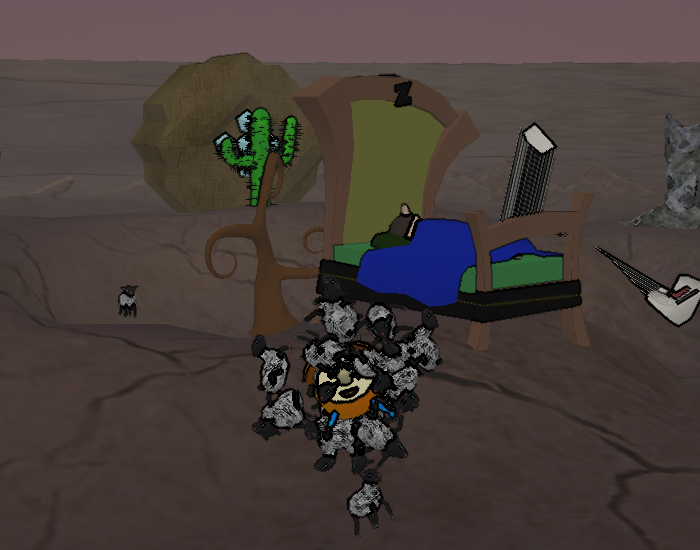
I spent last weekend at the Entertainment Technology Center (ETC) for the Global Game Jam, designing and programming a game about sheep. The process of coming up with a game concept in our team of 7 randomly thrown together geeks (though we ended the weekend with 5 [attrition, not cannibalism {though I did get pretty hungry from all the coding}]), was quite a whirlwind. Somehow we started at a blob of mercury and ended with a dream in which you control an alarm clock being chased and covered by bouncy sheep. The premise is that you’ve fallen asleep counting sheep, which follow you into your dream. The sheep try to keep you in the dream forever by smothering the alarm clock and preventing it from ringing. To win, you must knock all of the sheep off of the clock by ramming into obstacles or falling from heights, and then quickly roll back to the bed before any sheep catch up and reattach. It plays a lot like a reverse Katamari Damacy, though that was not necessarily the intent.
This is the second time I’ve done a 3d game, and this one came out far better than Robobear Apocalypse, an entry for the Wild Pockets Game Jam. The engine this uses is Panda3D, another product of the ETC. It was actually quite nice to learn and use, and I was impressed by how well it worked cross-platform. It helps that it uses regular old Python instead of proprietary languages that seem to be all the rage in game engines today. I also learned just how nice it was to have modellers/animators on a game project. Finally a game that isn’t made up of spheres, cubes, and stock models!
You can download the game on its Global Game Jam page. The .zip on that page contains the source and a Windows installer. You can also run the source directly in Linux or Windows if you have Panda3D installed. It seems most distros have it available in their repos, but if not, there are packages downloadable at the Panda3D site. It’ll run ok on just about anything that isn’t integrated graphics. The game isn’t perfect and certainly isn’t bug free, but it is a fun light hearted experience and the result of only 48 hours of work.